wish you a long, happy & productive life
wish you a long, happy & productive life is a body of work that I created from 2023 to 2024 during my Master of Fine Arts (MFA) at Memorial University of Newfoundland. These textile and ceramic works were created in the aftermath of my father’s sudden death in response to the enormous grief that I felt.
133 Crescent Road, Living Room, 1985–1991 & 133 Crescent Road, Garden with Swing Set, 1985–1991
The first two works of the series, 133 Crescent Road, Living Room, 1985–1991, and 133 Crescent Road, Garden with Swing Set, 1985–1991, are scenes of my childhood home and garden in London, England. Both works explore migratory and diasporic grief, and notions of home and belonging. This familial grief resulted from my family’s difficult immigration in 1991 from London, England, to Quebec, Canada, (my mother’s homeland) and also the subsequent divorce of my parents and later estrangement of my mother. This migratory grief echoes the generations of migratory grief on my paternal side (from Sri Lanka to Malaysia, and beyond) and the grief present in our South Asian diaspora.
Drawing these scenes allowed me to remember what no longer exists––a childhood home, a nuclear family, my father––and was an act against loss. The objects surrounding each drawing float disjointed on the backdrop and speak to how I remember: scattered elements from the past that emerge nebulous into the present.
The works incorporate vintage British textiles that were ubiquitous in my childhood in London. Using these fabrics is a way to connect me to my childhood and to critically engage with the history of Indian textiles and their relationship to British colonialism, which includes the devastating impacts of British colonialism on India’s textile industry.
The sari borders are an ode to my South Asian heritage and speak to the geographic borders that are part of my family’s story. The sari borders here are both cartographic and containing. Cartographic in their allusion to the varied geographic borders of my lineage; containing in that each border acts as a frame, holding memories, feelings, preserving a family in a time and space that is now, in many ways, lost.
133 Crescent Road, Living Room, 1985–1991, 2023, oil sticks, textile paints, wax pastels, embroidery, appliquéd leather and various fabrics, on hand-dyed cotton and vintage floral cotton, with sari borders and sari tassles, 57 x 53.5 inches.
133 Crescent Road, Living Room, 1985–1991 (detail), 2023, oil sticks, textile paints, wax pastels, embroidery, appliquéd leather and various fabrics, on hand-dyed cotton and vintage floral cotton, with sari borders and sari tassles, 57 x 53.5 inches.
133 Crescent Road, Garden with Swing Set, 1985–1991, 2023, oil sticks, textile paints, wax pastels on hand-dyed cotton and vintage floral cotton, with sari borders and sari tassles, 68 x 47 inches.
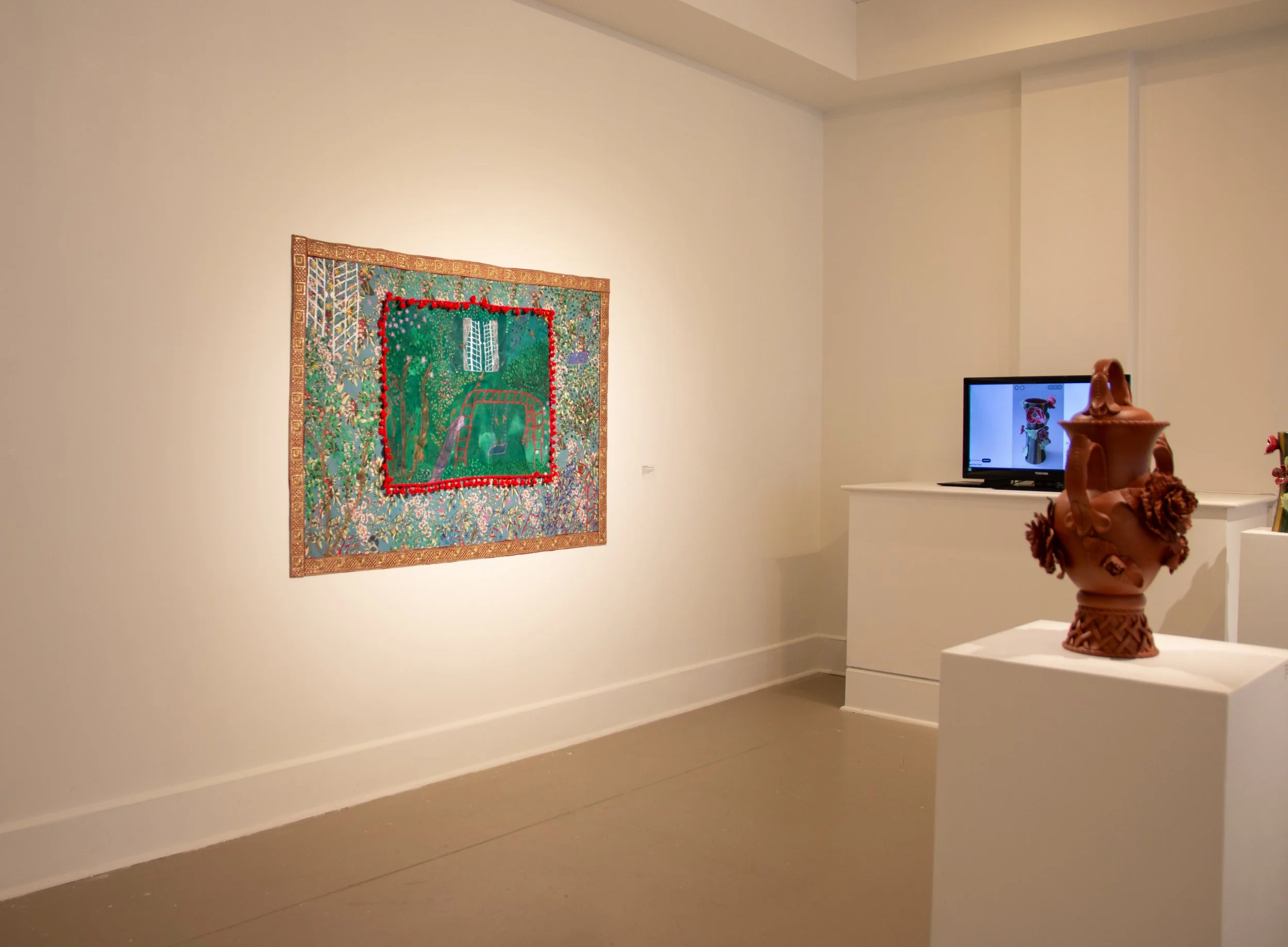
133 Crescent Road, Garden with Swing Set, 1985–1991 (detail), 2023, oil sticks, textile paints, wax pastels on hand-dyed cotton and vintage floral cotton, with sari borders and sari tassles, 68 x 47 inches.
Living Area, 51 Vincents Way
Living Area, 51 Vincents Way shows the domestic rituals that my father and I shared in the last few years of his life. After a decade living in Berlin, Germany, I moved to Antigonish, Nova Scotia, in 2019, where my father lived and worked; new daily routines formed between us. As neighbours, we weathered the pandemic together and shared evening meals with his partner and our families. His home on Vincent’s Way was a testament to his hard-earned, late-arrived financial security (an immigrant priority), and it was the backdrop to a vibrant and comforting domestic life and to his important relationships; as father, partner, grandfather, and friend. When he died, this family life on Vincent’s Way ended.
An immigrant from Malaysia born to Tamil Sri Lankan parents, my father was a domestic person. In the aftermath of his death, as an artist, it felt right to me to contemplate scenes of his domestic life, where so much of our relationship had been lived. He enjoyed gardening and cooking. He enjoyed pruning his plants. He sought stability and nurture in his home. I am the same way. As immigrants, home is hard earned.
The drawings in the center of this work feature scenes of that domestic life: meals shared, tea drank, kitchen stools, TV time. I drew these rituals using cold-water dyes and water-based resists, which is nod to the Malaysian batik that my father grew up around. For the backdrop, I screenprinted my dad’s handwriting from a birthday card that he had given me on my fortieth birthday. In it he wrote: Wish you a long, happy & productive life. Love, Dad.
I used sari tassels to complete the work and let a strand fall onto the floor, which felt right, both compositionally and because the story of our relationship continues for me, despite his death.
Living Area, 51 Vincents Way, 2024, screenprinted cotton from a card that my father wrote to me on my fortieth birthday, water-based resist, textile paints, wax pastels, cold-water dyes on cotton with sari tassels and sari trim, 55 x 58 inches.
Living Area, 51 Vincents Way (detail), 2024, screenprinted cotton from a card that my father wrote to me on my fortieth birthday, water-based resist, textile paints, wax pastels, cold-water dyes on cotton with sari tassels and sari trim, 55 x 58 inches.
CERAMIC PAINTINGS
These six ceramics are small paintings and drawings of the domestic homescapes that my father and I shared. I created these iterations because I felt the need to remain in the comforting rituals that my father and I shared, which his abrupt death put an end to.
Pruning the Geraniums features an imprint of his pruning shears. My dad’s geraniums were admired by anyone who spent time in his home, and he loved snipping away at them. The second ceramic Gardening Together shows me and my dad gardening: he pruned, I dug and planted, he raked and weeded, I mowed. My father and I immigrated several times in our lives––as a family and as individuals––and homemaking and gardening were activities that grounded us to our new surroundings. The trio After Suppertime depict our after-supper ritual: watching TV and drinking tea. The sixth work Palliative Room is a scene of my dad’s last home, a room in the palliative care unit where he spent the final three weeks of his life. My sister, his partner, and I were with him when he died.
Pruning the Geraniums, 2024, glazed stoneware, underglazes, 8.5 x 11 inches.
Gardening Together, 2024, glazed stoneware, underglazes, textile paint, 10 x 12 inches.
After Suppertime (tv), 2024, glazed stoneware, underglazes, textile paints, 9 x 9 inches.
After Suppertime (teapot), 2024, glazed stoneware, underglazes, textile paints, 8 x 9 inches.
After Suppertime (sofa), 2024, glazed stoneware, underglazes, textile paints, chiffon, 7.5 x 11 inches.
Palliative Room, 2024, glazed stoneware, underglazes, textile paints, 12 x 13 inches.
CERAMIC IMPRINTS
These eight small ceramics are clay imprints of a selection of my dad’s personal objects: a checkered sock; a pair of his trademark aviator sunglasses; his zippered fleece that he wore on walks; his pruning shears for gardening; leaves from his avocado plant that he planted from seed with his grandson; his pruning scissors used on his geraniums; an antique coaster from a set he found on his antiquing adventures; and the birthday card that he wrote me for my fortieth birthday. I chose to imprint the things that reminded me of how he lived his life.
Time took on another dimension after he died: each day moved me away from the moment of his death, the passage of time a relief from the acute pain caused by his absence. But time also seemed––still seems––to remain somehow in a constant present; an unreliable state with a mutable before and after, existing outside the temporal order. In working with clay, the passage of time was visible: the material hardened quickly, the window of its pliability narrowing fast. The clay was soft when I imprinted the objects, but with each passing hour, it brittled. After I glazed the works, and they exited the kiln, they seemed like fossils, stark reminders of my dad’s absence.
In the last years of his life I was very aware that my father could die soon given his age, but the abruptness of his illness and death (he died eight weeks after showing symptoms of pancreatic cancer) and the magnitude of his absence created such an upset to my existence. Creating the ceramic imprints was a way to cement the death, render visible the stoppage of time. His death feels like an astonishing vanishing act––it still feels bewildering that my father could just disappear from life. What surprised me is how present our relationship remains in his absence; in death––like in life––he is my father and I am his daughter.
Pruning Shears, 2024. glazed stoneware, 11 x 8.6 inches.
Avocado Plant Leaves, 2024. glazed stoneware, 9.8 x 5.9 inches.
Antique Coaster, 2024. glazed stoneware, 9 x 8.6 inchesAntique Coaster, 2024. glazed stoneware, 9 x 8.6 inches.
Zippered Fleece, 2024. glazed stoneware. 10.6 x 6.2 inches
Sunglasses, 2024. glazed stoneware, 8.2 x 8.2 inches.
Sock, 2024. glazed stoneware. 10.4 x 6 inches
Pruning Scissors, 2024. glazed stoneware, 9 x 7.3 inches.
Birthday Card, 2024, glazed stoneware. 7.4 x 10.6 inches.
KARUNA’S THINGS
Karuna’s Things is an assemblage featuring some of my father’s objects: his geraniums, his pruning scissors, his antique coaster, his teapot, his cooking utensil, and his sunglasses, placed on his antique tablecloth on his antique table. I chose these objects because they each represent a different side to my dad, and certain objects are echoed in the ceramic imprints, tying this body of work together.
Karuna’s Things, 2024. His geraniums, his pruning scissors, his antique coaster, his teapot, his cooking utensil, and his sunglasses on his antique tablecloth and his antique table. assemblage, 43.3 x 20 x 20 inches.